.svg) Aldermans News
Aldermans News
.svg) (0)1752 201200
(0)1752 201200


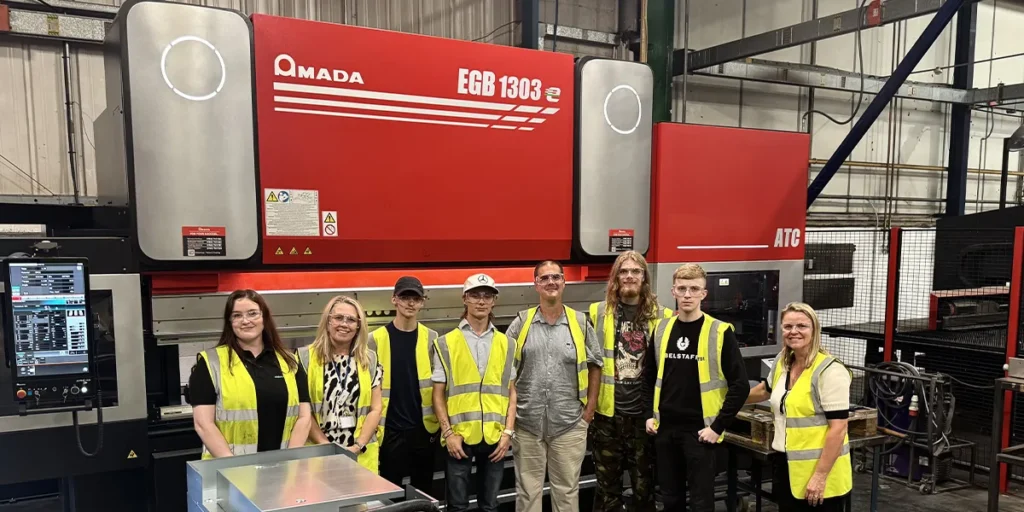
Earlier this year, we installed a new Amada EGB-1303ATCe press brake in the workshop. It is a major investment and has already begun to alter our approach to press operations, particularly for smaller batch jobs.
What is different about this machine?
The EGB-1303ATCe features an Automatic Tool Changer, known as an ATC. Essentially, this means the tooling needed for each job loads and positions itself automatically via the machine’s control console. The operator programmes the machine, and the tools clamp into place. No manual handling of dies, and no searching around the workshop for the correct setup.
On a traditional press brake, setting up for a new job can take about 20 minutes. On this machine, the same setup takes roughly 2 minutes. Over a working day where six to eight different jobs may need setting up, that can recover around an hour and a half of productive machine time. The result is quicker turnaround and less waiting between jobs.
Capacity and capability
The machine has a pressing force of 1,300 kN and a maximum bending length of 3,110 mm, making it well suited for both smaller precision components and larger fabrications. It handles material thicknesses from 1 mm to 6 mm and can accommodate parts up to 3 m in length using the integrated AMTS III automatic clamping system. Bending speed runs at up to 25mm/sec, with approach and return movements at 250mm/sec. Backgauge positioning accuracy is ±0.01mm, maintaining consistent tolerances across a run without relying on operator adjustments between parts.
Why it matters for small batch work
Increasingly, our work involves smaller quantities. A batch of five components here, twenty there, sometimes a hundred. With a conventional press brake, frequent setups reduce productive time and can make small orders less economical to run efficiently.
The ATC changes that. Switching between jobs is quick and consistent, so short-run work is managed without compromising quality or speed. The machine can accommodate multiple bend angles within a single component, including 90-degree, 60-degree, and 45-degree folds in the same job.
The built-in BI-S II bending indicator automatically manages angle accuracy by checking the bend at up to three points within a measurement range of 90 to 165 degrees and applying corrections without requiring a separate inspection step. This eliminates a common source of scrap on complex or multi-station jobs.
Better for consistency and training
The automated setup process minimises operator-to-operator variation and makes the machine easier to learn. For new team members, the learning curve is shorter, and the risk of setup errors causing scrap is significantly lowered.
What this means for you
If you place orders with us for fabricated components involving press work, you should notice benefits in faster lead times and consistent, accurate results. With backgauge accuracy to ±0.01mm and setup times reduced from 20 minutes to around 2, the process is now quicker and more repeatable across both small prototype runs and larger production batches.
If you have components that need precise press work, whether for a small prototype run or a repeat production batch, we’d be happy to discuss your requirements. Find out more about our metal pressing capabilities or contact the team to talk about your next project.